Fulfillment and warehousing for ecommerce: how to store, pick, pack, and ship at scale
Fulfillment and warehousing are the systems behind fast, accurate ecommerce delivery. It starts with receiving stock, checking quantities, and storing items in labelled locations so staff can find them in seconds. From there, picking turns orders into a clear checklist, packing protects products and keeps parcel size and cost under control, and shipping completes the flow with correct labels, tracking, and carrier handoff.
To scale, you need repeatable rules: consistent SKU naming, bin locations, barcode scanning, and cycle counts to prevent stock errors. You also need defined packing standards, cut-off times, and exception handling for damaged items and returns. When these steps are tight, you ship more orders per day with fewer mistakes and better margins.
What fulfillment and warehousing mean (and where they fit in your order flow)
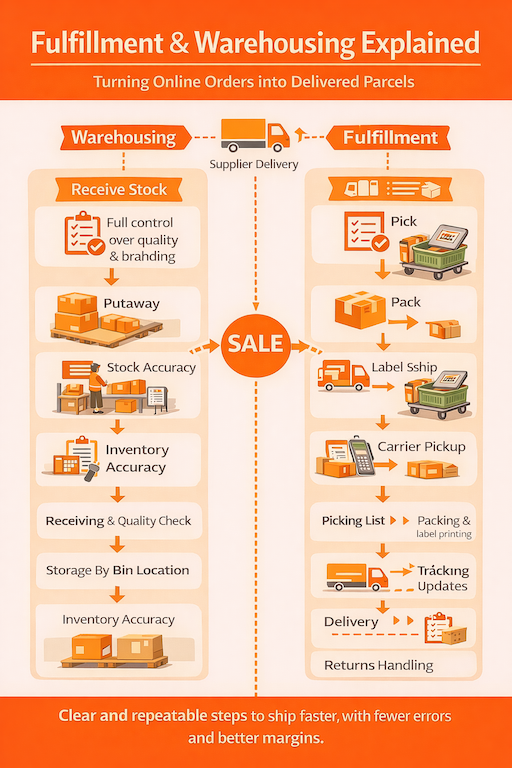
Fulfillment is the end-to-end process of turning an online order into a delivered parcel. Warehousing is the storage and control side of that process, covering how products are received, organised, and counted. In your order flow, warehousing happens before the sale (receiving, putaway, stock accuracy) and fulfillment starts the moment an order is paid (pick, pack, label, ship).
A simple order flow looks like this: supplier delivery → receiving and quality check → storage by bin location → customer order → picking list → packing and label printing → carrier pickup → tracking updates → delivery → returns handling. When these steps are clear and repeatable, you ship faster, reduce errors, and protect profit.
In-house vs 3PL vs hybrid: choosing the right operating model
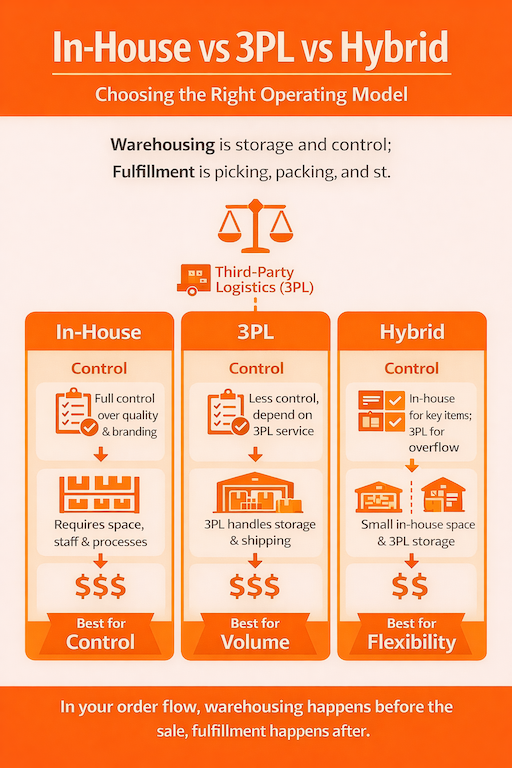
Choosing between in-house, 3PL, or hybrid fulfillment comes down to control, cost, and complexity. In-house fulfillment gives you full control over stock, packing quality, and branding, but it requires space, staff, processes, and ongoing management. A 3PL (third-party logistics provider) handles storage and shipping for you, which can speed up delivery and reduce daily workload, but you pay pick and storage fees and rely on their service levels.
A hybrid model keeps your best-selling or fragile items in-house while a 3PL ships overflow, bulky products, or international orders. If you have steady volume and simple products, in-house can work well. If volume spikes, multi-channel orders, or fast shipping expectations are the main challenge, a 3PL or hybrid is usually safer.
Warehouse layout basics that reduce pick time and errors
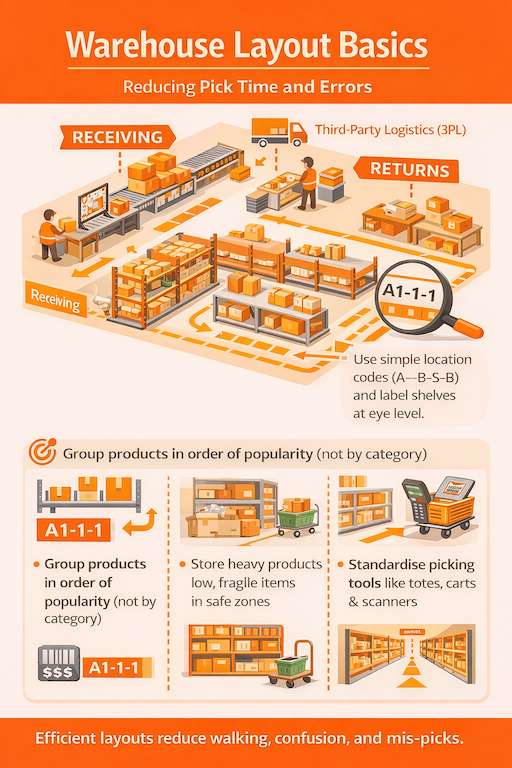
A good warehouse layout reduces walking, confusion, and mis-picks. Start by grouping products by order behaviour, not by category. Keep fast-moving items (your top sellers) closest to the packing station. Store heavy or bulky products low, fragile items in protected zones, and small parts in clearly divided bins. Use simple location codes (Aisle–Bay–Shelf–Bin) and label every shelf at eye level.
Keep receiving and returns away from pick paths so stock does not block traffic. Create one-way routes where possible to prevent collisions and backtracking. Standardise picking tools such as totes, carts, and barcode scanners. When every item has one obvious home and every picker follows the same route, you cut pick time and reduce errors.